

Last Modified: 08/21/26
Learning points & miles is like learning a new language. The first important concept I learned is understanding multipliers and which cards work best for my spending habits.
But underlying any understanding of multipliers is understanding my own spending habits through budgeting.
Affiliate Disclaimers /Disclosure & Terms & Conditions: This blog is reader supported and this contains affiliate/referral links. If you book or buy through these links, I may earn a commission or referral bonus.

Step 1: Where is my money going?
Coming out of graduate school, I had a decent amount of student loan debt and a goal of being part-time. My husband is a public school teacher. This required us to budget in a way I wasn’t familiar with.
We started with Dave Ramsey, and while I don’t agree with most of what he says or the way he says it, we did learn a lot about not accumulating more debt and living within our means.
But it wasn’t until I found YNAB that our understanding of budgeting took off. In the 17 years since finishing training, I’ve rarely worked over 75% FTE (full-time equivalent), and most of the time I’ve been around 60% FTE. All of this is thanks to budgeting.
While I absolutely love YNAB, the software is challenging to manage with multiple credit cards. A few years ago, I switched to Monarch and set it up similarly to my old YNAB account. I love seeing all of my transactions, accounts, and net worth in one place.
If you’d like to try Monarch for free for 7 days, you can use my Monarch referral for 50% off your first year. I may earn a small commission. Thanks for supporting the blog!
For points and miles, this is key because I can see how much I spend on the common multiplier categories: groceries, dining, gas, entertainment, etc. I can then make sure I am using the most ideal card for those purchases.
Step 2: Monthly spending estimates
Now that I know how much I spend each month, on average, I can look at the different credit card multipliers. For personal cards, many big names offer 2-4X multipliers for groceries, 3-4X for dining, 2-3X for gas, and 3X for entertainment.
Here is a fictional budget to guide my examples below.
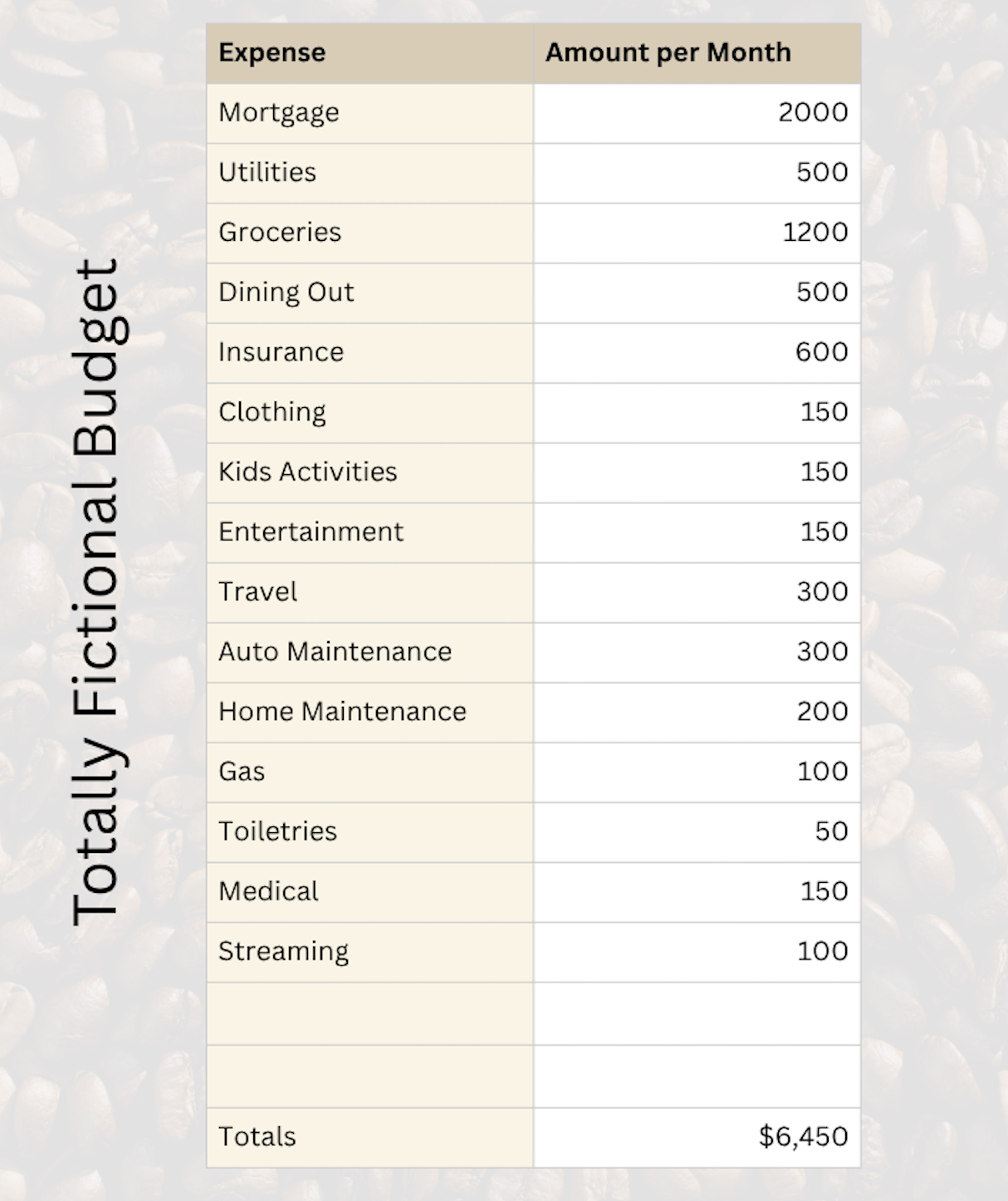
Step 3: Estimating points earning potential
A single, multi-multiplier travel rewards card
Using my made-up budget, if I had a single card like the Chase Sapphire Preferred, outside of the sign-up bonus, I’d earn about 8,550 points per month. Over 12 months, that’s about 102,600 points and 177,600 points the year I signed up for the card. Not bad at all!
That is enough for one international trip or several small domestic trips.
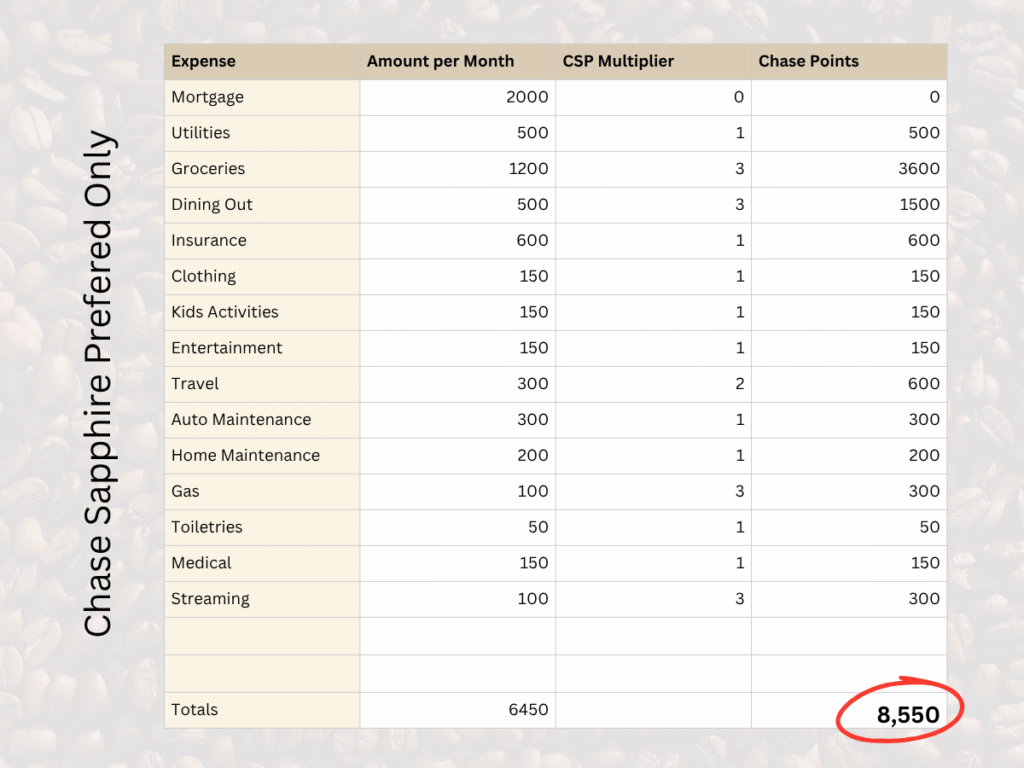
If you qualify for the Chase Sapphire Preferred, you may earn a 75K sign-up bonus. If you use my CSP referral link, I may earn a referral bonus. Thanks for supporting the blog!
Multi-multiplier travel rewards card & a 2X everything rewards card
The next level of multipliers is combining a multi-multiplier card with a card that has a flat rate for all uncategorized spending. The Capital One Venture card gives 2X points on categories like insurance, kids’ activities, medical, and clothing.
Together, they bring my average points accumulation to 10,800 per month and 129,600 per year. Add the sign-up bonuses (75,000 each) for the first year, and that is 279,600 points!
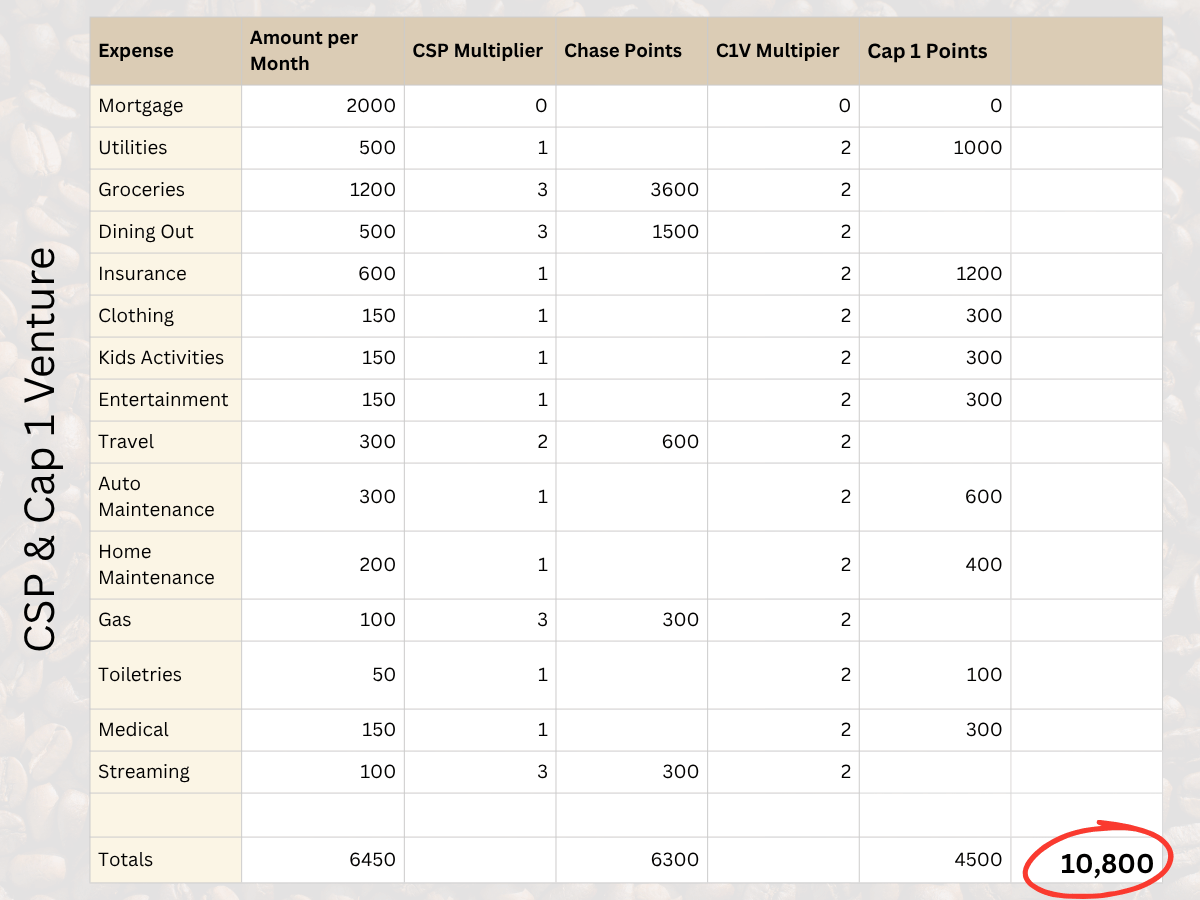
If you qualify for the Capital One Venture card, you may earn a 75K sign up bonus. If you use my Cap 1 Venture referral, I may get a referral bonus. Thanks for supporting the blog!
Highest spending category multiplier rewards card & a 2-3 flat rate rewards card
For our family, our two biggest expenses are mortgage and food. If I used just an Amex Gold for dining out and groceries and the Bilt card for everything else, including mortgage, I could accumulate 17,050 points per month (with the points accelerator at 3X points).
That would be about 204,000 points per year and 354,000 points the first year with the sign-up bonuses.
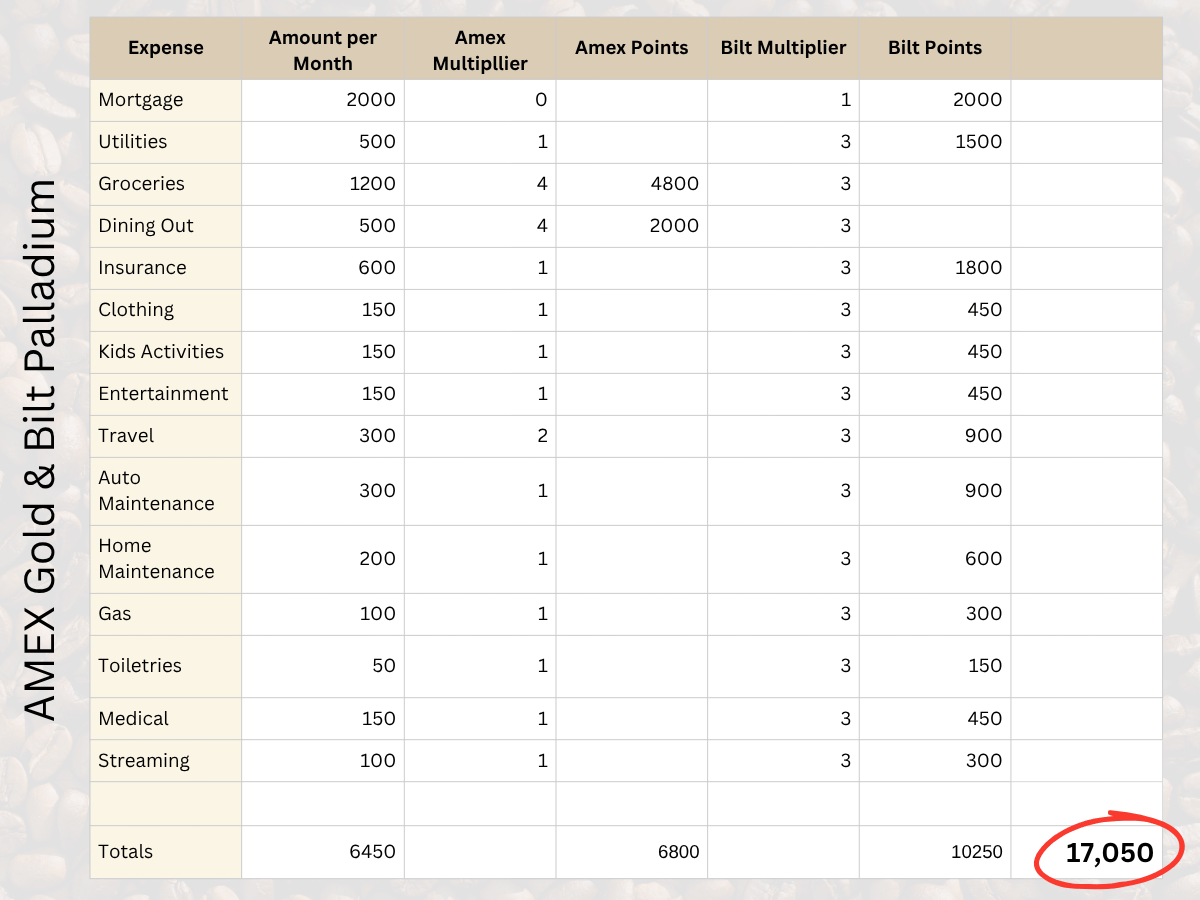
If you qualify for the Amex Gold, you may earn a 100K sign-up bonus. If you use my Amex Gold referral link, I may earn a referral bonus. For the Bilt Palladium, you may earn a 50K points and $300 in Bilt cash. I may earn a referral bonus if you use my Bilt referral link. Thanks so much!
A flat rate card for everything with a shopping portal
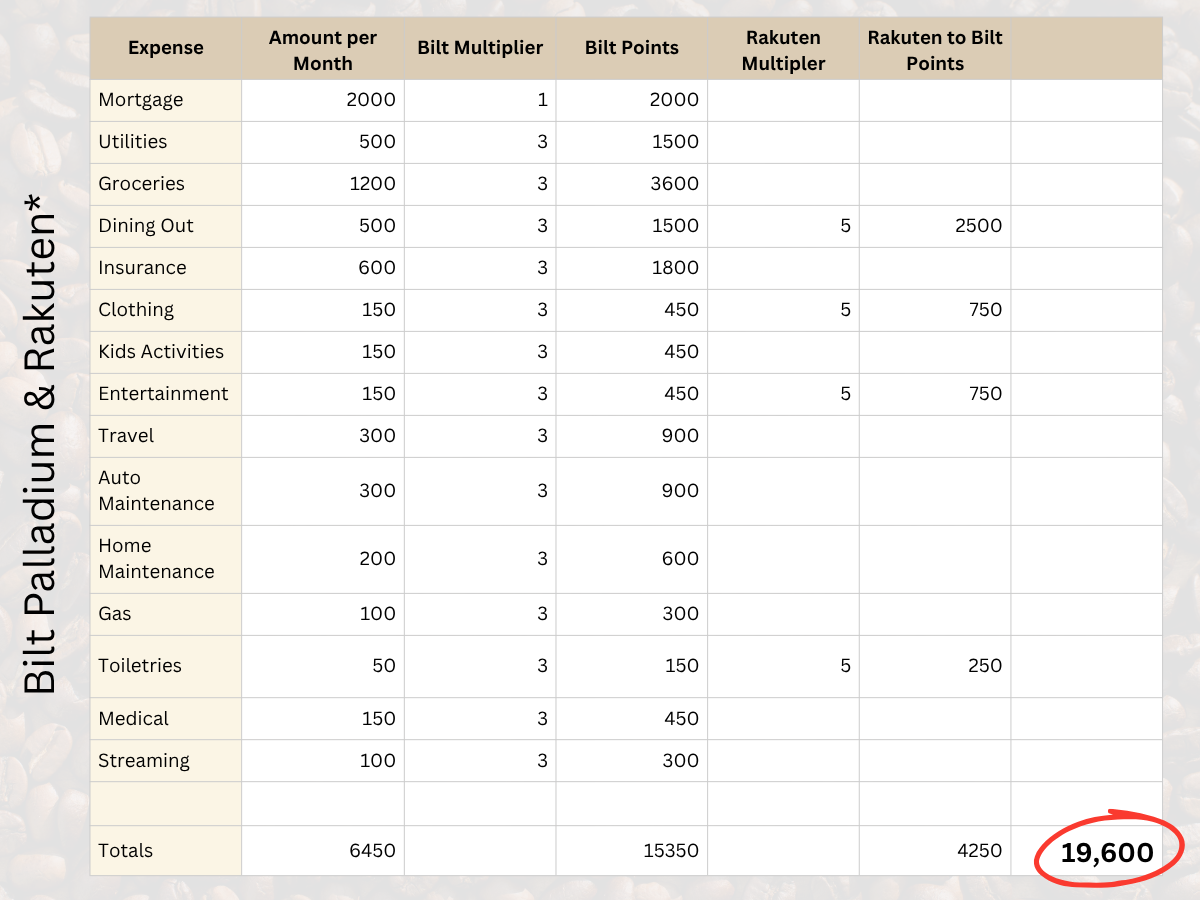
My husband doesn’t really want to think about which card to use. For this example the I only used the Bilt Palladium card with an authorized user card to maximize the point accelerator. With the addition of Rakuten for certain purchases like clothing, dining out, and entertainment to maximize points earning.
I estimated Rakuten an average of 5X on purchases, but with planning ahead, patience, and notifications on SaveWise, I have seen multipliers as high as 20X.
With this strategy, I estimated 19,600 points per month. This would be about 235,000 per year and 290,000 the first year with sign-up bonuses.
For the Bilt Palladium, you may earn a 50K points and $300 in Bilt cash. I may earn a referral bonus if you use my Bilt referral link.
For Rakuten, if you use my Rakuten referral link, we both may earn 5000 points or $50 cash back. Thanks so much!
So you can imagine: a combination of point-earning cards with specific multipliers, opening cards for sign-up bonuses based on spending habits and capacity, and using shopping portals for things on the “to buy” list can lead to lots of points accumulation.
Feeling confident with points and miles starts with understanding your spending habits through budgeting, then strategically using credit cards with the best multipliers for your expenses. Using these methods, along with a few rewards cards and shopping portals, I accumulated points quickly and went from feeling overwhelmed to ready to book my first points booking.
If you want to learn the basics of points and miles, start with my How I Got Started with Points & Miles post and my Favorite Cards page.
If you want to see how I use points and miles for trips, take a peek at my London Trip Report & Paris Trip Report!
Have questions about points & miles? Shoot me a question on my Instagram!
Cheers!
exploring:
